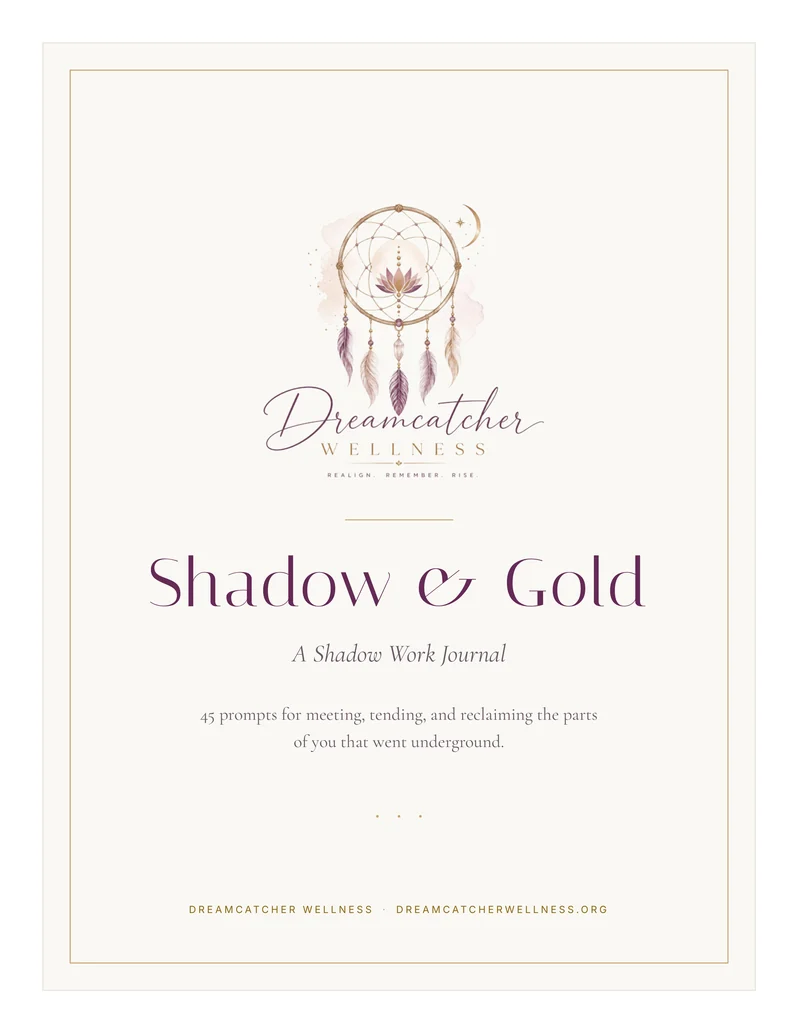
Shadow & Gold
A printable shadow work journal with 45 guided prompts for meeting the parts of yourself you learned to hide.
Written by an ICF PCC coach who spent two decades being the competent one, and ignored what her body was telling her until it stopped asking politely.
Instant PDF. Yours to print as often as you like.
Why I made this
This is the journal I needed years before I went looking for one
I was the one with the good title, the full calendar, and an answer for everyone. Recovering perfectionist, former hyperachiever, ex-people-pleaser, forever restless wanderer. I could tell you what anyone in the room needed. I couldn't have told you what I needed, and I wasn't asking.
My body asked for me. Quietly for a long time, and then it stopped being quiet. It's just stress. It's just this season. I can push through. I said all of it. I believed some of it. I kept going anyway, until my body made a decision I hadn't been willing to make.
Here's the part I don't love admitting: none of it surprised me. I had known for a long time. I just hadn't wanted to look at what I already knew.
What turned things around wasn't a new protocol or a better planner. It was finally being honest about the parts of me I had been managing instead of meeting. Shadow & Gold is those questions, in the order I wish someone had handed them to me.
If the term is new to you
What shadow work actually is
Shadow work is the practice of turning toward the parts of yourself you learned to hide, deny, or disown, and discovering they were never the enemy.
Your shadow is not your darkness. It's simply everything that fell outside the light of who you were allowed to be. The anger that wasn't welcome at your dinner table. The wanting you decided was too much. The part of you that knew something and got talked out of it.
Carl Jung gave it the name. Every wisdom tradition has walked some version of the path. In the language of the Gene Keys, every Shadow contains a Gift, which is the same energy unfrozen.
None of it is about fixing you. You are not broken. You're partial, the way all of us are partial, and this is a structured way to go back for the rest of yourself.
What's inside
Eight turnings, forty-five prompts
Each prompt gets a full page with room to write and a date line, so you can see the movement when you come back to it months later.
The Invitation
Meeting your shadow
Before you can reclaim a part of yourself, you have to admit it exists. This first turning is about noticing what you already know and have agreed not to look at.
The Mirror
Triggers and projection
What we can't own in ourselves we tend to find in other people, usually at a volume that doesn't match the offense. Irritation and frustration are the map.
The Inheritance
Family, lineage and conditioning
Most of the rules you live by were written before you could read. They were survival strategies once. This turning is not about blame, it's about authorship.
The Mask
Perfectionism, pleasing and performing
The mask is not a lie. It's a brilliant, hard-working adaptation that once earned you safety or applause. The question is whether you can set it down.
The Exiled
Anger, envy, grief and desire
These four get locked out of the house early, especially for anyone taught to be good, easy and low-maintenance. They don't leave. They wait in the yard.
The Body
What you carry
The body keeps its own records and doesn't round the numbers. When the mind has a tidy story and the body disagrees, the body is usually the better witness.
Worth, Power and Visibility
Taking up your own space
Sometimes what we hide isn't dark, it's bright. Our power, our wanting, our capacity to take up room. This is the golden shadow.
The Alchemy
Shadow into gold
Nothing here gets thrown away. In alchemy the base material isn't discarded, it's transmuted. This last turning is where you go back for the gift.
What you get
A finished journal, not a worksheet pack
45 full-page prompts
Each with a follow-on question underneath, a date line, and twenty ruled lines. Room to actually write, not three lines in a box.
A grounding practice
Three minutes to open, five to close. This is what keeps the work sustainable instead of destabilising, and it's not optional decoration.
Shadow into Gold worksheet
A two-column page for naming the shadow as you met it, then naming the gift living inside it. The right-hand column often arrives weeks later.
Three integration pages
What I met, what I'm ready to set down, what I'm reclaiming. For looking back across everything once you've been through it.
67 pages, instant PDF
Delivered the moment you check out. Print at home on US Letter, or take it to any print shop. The margin is set wide so it three-hole punches or spiral binds without losing a word.
Yours to keep and reprint
Print a fresh copy whenever you want to work through it again. The same prompt answers differently in six months, and that difference is the evidence.
Honestly
Who this is for, and who it isn't
This is probably for you if
- You're successful on paper and quietly exhausted in a way rest doesn't fix
- You can name what everyone around you needs, and go blank when asked what you need
- You've read about shadow work and want somewhere structured to actually start
- You'd rather sit with a hard question than be handed an affirmation
- You're a coach, therapist or practitioner looking for prompts to work with yourself
It's probably not, if
- You want a quick fix, or a journal that tells you you're already perfect
- You're in acute crisis right now (please reach out to a licensed therapist instead, this will keep)
- You want someone else's interpretation of your answers rather than your own
Before you buy
Questions people ask
What is a shadow work journal?
A shadow work journal is a guided notebook that walks you through writing prompts designed to surface the parts of yourself you've learned to hide, deny or disown. Rather than an open blank page, it gives you a sequence of questions in a deliberate order, along with space to answer them by hand. Shadow & Gold contains 45 such prompts across eight themed sections, plus a grounding practice to open and close each session.
Do I need any experience with shadow work to use this?
No. The journal opens with a plain-English explanation of what shadow work is, what it isn't, and how to pace yourself, before you reach a single prompt. If you've never heard of Carl Jung or the Gene Keys, nothing here will be over your head. If you've done years of this work, the prompts are written to go deeper than the usual list.
How long does it take to work through?
As long as you want. One prompt is enough for one day, and 45 prompts is roughly a year of Sunday mornings if you take it slowly. Some people move through a section a week. There's no schedule built into it, deliberately, because racing through shadow work tends to defeat the point.
Is this a physical book or a digital download?
It's a digital download. You receive a 67-page PDF the moment you check out, formatted for US Letter (8.5 x 11 inches). You can print it at home single or double-sided, or take the file to a print shop. The inside margin is set wide so it three-hole punches or spiral binds without cutting into the text.
Can I print it more than once?
Yes. The file is yours to keep and reprint for your own use as many times as you like, including printing a fresh copy to work through a second time. It's licensed for personal use, so please don't resell or redistribute it.
Is shadow work the same as therapy?
No, and this journal is not a substitute for it. Shadow work is a self-reflection practice, not a clinical treatment, and a journal cannot assess you, respond to you, or hold anything with you. It works best alongside professional support rather than instead of it. If you're working with a therapist, bringing what surfaces into that room is a good use of both.
What if a prompt brings up something difficult?
That's the work doing its job rather than a sign you're doing it wrong, and the journal is built with that in mind. Every session is bookended by a grounding practice, the pacing guidance says plainly that one prompt is enough for a day, and the opening pages name when to stop and reach for support. If you find yourself flooded, or returning to something that feels unsafe to hold alone, please stop and contact a licensed therapist or counsellor.
How do the Gene Keys relate to shadow work?
The Gene Keys frame every Shadow as containing a Gift, the same energy in a different state. That framing runs underneath the journal's final section, Shadow into Gold, where you name a shadow you met in the pages and then name the gift living inside it. You don't need to know anything about the Gene Keys or Human Design to use the journal, but if you already work with them, the structure will feel familiar.
Who wrote it?
Kelly Pasztor, an ICF PCC-credentialed coach and Intuition and Human Design expert with more than twenty years of experience and 750+ coaching hours. She wrote it out of her own turn through perfectionism, people-pleasing and hyperachievement, and the autoimmune diagnosis that followed ignoring it for too long.
And so
No promises, just the questions
I'm not going to promise you anything. Journaling didn't cure me and it won't cure you. But paying attention sooner is the one thing I would go back and give myself, and this is my attempt to hand it to you earlier than I got it.
If you're already carrying a diagnosis, you're not behind. You're further into the conversation your body has been trying to have with you.
Instant download
Shadow & Gold
$33
Your copy arrives the moment you check out, ready to print. Take your time in there. Be honest. Be kind to yourself while you do it.
Questions first? Send me a note, or see how we could work together.